Tampilkan postingan dengan label Conservation. Tampilkan semua postingan

Senin, 20 Januari 2014

Side-B of Redang Island: Turtle Conservation


Who would have expected to see turtles at Redang Island – the island for sun and fun! On the flip side though, not many people know there’s a turtle sanctuary that is successfully managed by the Sea Turtle Research Unit (SEATRU), Universiti Malaysia Terengganu at Chagar Hutang.  Green turtles and Hawksbill turtles have been busy heading there and its good news for turtle conservation! It had not been easy getting them to nest and hatch there but its staff and volunteers are seeing the fruits of their labour!

Before we got to see turtles later in the evening, we had a one day stopover at the one and only primary school, SK Pulau Redang.  All 210 students were involved in the science activities we arranged, while their teachers did adult stuffscience learning workshop.  In other words, the whole school was engaged with Petrosains!  Wow!  We’ve never met a bunch of enthusiastic and eager students!  They were treated to an interactive science show (they actively participated), a DIY microscope hands-on activity & quiz called En. Hangman. It was indeed an energetic and deafening but satisfying session! 
Hands-on science activities by Petrosains
The Teachers' Workshop by Educators Centre, Petrosains
The turtle sanctuary was the opposite of what we experienced at SK Pulau Redang.  Chagar Hutang is located on an isolated beach on the most northern part of the island - away from the hustle and bustle of tourist activities.  It is quiet and serene except for the occasional burst of laughter and a flurry of activities from the human residents, which is not many!

The beach is off limits to tourists and casual visitors except for SEATRU researchers, workers and volunteers.  However the numbers are kept to a minimum to keep in check disturbances on the nesting beach.
The real work starts when most people are comfortable in bed, about midnight onwards. There’s a lot of waiting and it involves 9 stages until the wee hours of the morning. 

1. Landing (turtle just coming out from the water)
2. Crawling up the beach
3. Digging body pit
4. Digging egg chamber
5. Laying eggs
6. Covering the egg chamber
7. Sand-bathing (camouflage nest)
8. Crawling back to sea
9. Re-entering sea

During stages 1-5, turtles are very sensitive and may abort nesting if they are disturbed. Hence monitoring is done during these stages.  After the eggs are layed, staff will measure and tag the turtle; and label the nest.  Work doesn’t end here though.  The beach are also patrolled hourly from sunrise to sunset to inspect nests.  It seems like work is never ending!

(Source: SEATRU Volunteer Programme, Juanita Joseph & Liew Hock Chark)

Marking a turtle's nest.
Nesting took place on May 29, 2013
A SEATRU volunteer excavating a turtle’s nest
We were there to observe, and participated to a certain extend.  It was exciting when we saw turtles landing one by one (quite a long wait for each turtle) and later laying eggs.  Most of us never dreamt we’ll get to experience this precious moment.  It was just a handful of us plus the turtle!  Wow!  Powerful!

So folks, if you are looking for something meaningful and one in a lifetime experience, do checkout SEATRU.  You won’t be disappointed!
An interview session with Dr. Juanita Joseph (Project Leader of SEATRU) and Assoc. Prof. Liew Hock Chark (Founder of Sea Turtle Research Unit - SEATRU)


This article is written in conjunction with Science Engagement Session at SK Pulau Redang, Terengganu on 18 June 2013 and our educational visit to the Sea Turtle Research Unit, Universiti Malaysia Terengganu (SEATRU, UMT) on 18-19 June 2013.  Special thanks to Assoc. Prof. Liew Hock Chark (Founder of Sea Turtle Research Unit - SEATRU) and Dr. Juanita Joseph (Project Leader of SEATRU). Our appreciation to SK Pulau Redang.


Belangkas or Horseshoe Crab & Mangroves


HotSciencePetrosains

The belangkas or horseshoe crab is often called a "living fossil."  It has been estimated to have inhabited the Earth for over 300 million years!  However not many people know about this or even seen it up close.  Mangroves on the other hand are not pretty to look at – it’s smelly and its location is quite inaccessible.  However it has a unique ecosystem which is beneficial to us and our environment.
The objective of this particular engagement session is to provide an avenue for scientists from Universiti Malaysia Terengganu (UMT) to share their research in these two areas with the public. 
There were two teams involved – The Mangroves Research and Conservation Unit (MARU),
and the Horseshoe Crab Research Group.  Over the two days, the scientists and their assistants coaxed, encouraged and readily interacted and shared knowledge with the public.

Yes, our scientists are friendly and approachable indeed!

What are belangkas?
 The belangkas or horse shoe crab is an invertebrate descended from the trilobite, and is closely related to spiders, ticks and scorpions.  There are four species worldwide and three can be found in Malaysia.  Its blood is colourless and turns light blue when exposed to air (oxygen).  It reaches maturity at 9-12 years of age and the female is normally larger than the male.
 The Horseshoe Crab Research Group recently came up with a kit that uses belangkas blood to detect bacterial contamination.  This kit could be manufactured locally and could be considered as economically feasible for the breeder and manufacturer.
What are mangroves?
 Mangroves or bakau are found along sheltered coasts where there is saline soil & brackish water.  Based on research, mangroves have been in existence 70 million years ago.  There are currently 105 recorded species of mangrove vegetation in Malaysia (Sulong I. & M Lokman H, 2012).
Mangroves may be smelly and unsightly but it has many important roles and benefits. 
• It contributes to complex food webs.
• It is a breeding area and provides protection from predators.
• It is rich in nutrients due to the large amount of unconsumed fallen foliage.
• It acts as wind and wave breakers.
• The root system traps sediments.
• It has socio-economic importance.


This article is written in conjunction with Petrosains Science Engagement Session on 9-10 March 2013 with scientists from Universiti Malaysia Terengganu -
1. The Mangroves Research and Conservation Unit (MARU) headed by Pn. Siti Mariam Muhammad Nor
2. Horseshoe Crab Research Group headed by Dr. Faridah Binti Mohamad.


Coral Reefs


HotScience
Petrosains

What’s the fuss over corals?
Corals are pretty to look at and are definitely pleasing to the eyes!  Besides being a necessary prop in the aquarium and enhancing its appearance, what has it got to do with us anyway? 
Corals – What are they?
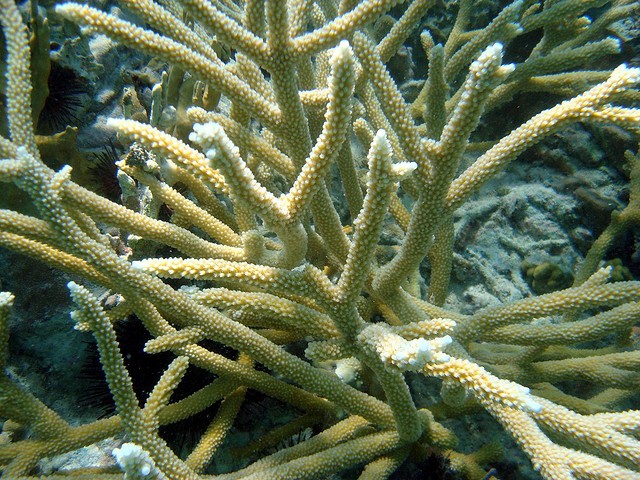
Corals are invertebrate animals (without a backbone) that are related to sea anemones.  They share the same characteristics - a simple stomach with a single mouth opening surrounded by stinging tentacles.  Each individual coral animal is called a polyp.  Polyps group together to form a colony by replicating copies of its original self through a process called budding.  When coral polyps die, they leave behind a hard, stony, branching structure made of calcium carbonate.
Corals are generally classified as either "hard coral" or "soft coral". Soft corals live in colonies that resemble brightly coloured plants or trees and don't have hard calcareous skeleton, instead they grow wood-like cores for support and fleshy rinds for protection.  Hard corals are known as 'reef building' corals.
What are coral reefs?
Reefs are usually made up of many colonies and are much bigger. These structures are formed when each individual polyp secretes calcium carbonate. The largest coral reef is the Great Barrier Reef, which spans 2,600 km off the east coast of Australia. It is so large that it can be seen from space. 
Massive corals tend to grow slowly, increasing in size from 0.5 - 2 cm per year. However, under favorable conditions (lots of light, consistent temperature, moderate wave action), some species can grow as much as 4.5 cm per year.
Threats
1. Water temperatures and ocean acidification linked to rising carbon dioxide levels.
• High water temperatures – condition called coral bleaching causes corals to lose the microscopic algae that produce the food corals need.
• Ocean acidification - more acidic seawater makes it difficult for corals to build their calcium carbonate skeletons.
2. Overfishing and overharvesting of corals disrupt reef ecosystems.
3. Invasive species -  greatly impact coral reef ecosystems through consumption of, and competition with, native coral reef animals.
4. Runoff from lawns, sewage, cities, and farms feeds algae that can overwhelm reefs. Deforestation hastens soil erosion, which clouds water—smothering corals.

How do corals contribute to the environment?
1. Coral reefs are sensitive indicators of water quality and the ecological integrity of the ecosystem.
• They tolerate relatively narrow ranges of temperature, salinity, water clarity, and other chemical and water quality characteristics.
2. They are important fishery and nursery areas, and more recently have proved to be very important economically as tourist attractions.
3. Reefs provide protection from erosion to coastlines and sand for beaches.
Get to know the corals
 Assoc. Prof. Dr. Hii Yii Siang in action


  Assoc. Prof. Liew Hock Chark in action


  Look,look...that is the corals!


Meet the corals

This article is written in conjunction with Petrosains Public Engagement Session on 15-17 December 2012 with scientists from Univeristi Malaysia Terengganu, Assoc. Prof. Dr. Hii Yii Siang and Assoc. Prof. Liew Hock Chark.

Part 5/7: Olive Ridley Turtles


Part 6/7: What's Threatening Them?


Part 7/7: What Should We Do?


Lindungi Alam Sekitar


5 tip mudah untuk melindungi alam sekitar


5 perkara mudah yang boleh dilakukan untuk  melindungi alam sekitar.


1. Membawa beg membeli- belah guna semula setiap kali pergi membeli barangan runcit. Dengan cara ini , saya dapat mengurangkan penggunaan beg plastik.  
2. Membawa bekas makanan dan minuman sendiri setiap kali membeli makanan dan minuman.
3. Kurangkan mencetak  dan menggunakan kertas guna semula semasa melakukan kerja di pejabat.

4. Mengumpul dan menggunakan air hujan untuk menyiram tumbuh-tumbuhan , membasuh kereta, mencuci lantai dan lain-lain.

5. Berkongsi kereta dengan rakan untuk ke tempat kerja.


Jadi, bagaimana dengan anda pula?


Posted by Ayu
Learning Specialist, Petrosains


Keunikan Gamat di Laut Sabah

Pengalaman yang sangat indah tentunya bakal dirasai oleh setiap orang apatah lagi sekiranya ia merupakan kali pertama berkunjung ke negeri Sabah. Sabah yang lebih dikenali sebagai Negeri di Bawah Bayu terletak di Kepulauan Borneo, Malaysia Timur. Negeri ini sangat kaya dengan hasil laut di samping hasil-hasil lain yang diusahakan oleh penduduk tempatan.


Tidak dapat dilafazkan dengan kata-kata apabila setiap pagi melihat betapa banyaknya hasil laut dan tangkapan nelayan seperi ikan, sotong, ketam dan udang yang segar dijual di pasar basah mahupun berdekatan dengan jeti pemunggahan nelayan. Hasil tangkapan laut yang dibeli di jeti boleh dibeli dengan harga yang lebih murah berbanding di pasar. Penduduk tempatan selalunya membeli hasil laut ini untuk dijadikan juadah lauk, ada yang membeli untuk diniagakan dan ada juga yang diproses untuk dijadikan ikan kering. Ikan kering dan udang kering pula boleh didapati dibahagian pasar kering, Kota Kinabalu.


Tatkala melintasi pasar kering ini, ada satu lagi haiwan laut lain yang dapat dilihat. Ia merupakan sejenis haiwan laut yang bewarna hitam, berbentuk seperti timun dan terdiri daripada pelbagai saiz dan jenis. Ia juga mempunyai banyak kelebihan dan banyak kegunaan bagi masyarakat setempat. Khazanah laut yang amat unik ini adalah 'gamat' atau dikenali juga sebagai 'timun laut' di sesetengah tempat kerana anggota badannya yang menjulur keluar berbentuk silinder seperti timun.

Gamat tergolong di dalam Filum EchinodermataHabitatnya adalah di dasar laut. Di Sabah, gamat dikeringkan untuk dieksport ke China, Hong Kong dan Singapura . Harganya boleh mencecah sehingga RM400 sekilogram. Gamat juga dijadikan makanan bagi penduduk tempatan . Di Semenanjung Malaysia, gamat dijadikan minyak ubat untuk merawat luka disebabkan ketahanannya yang mampu hidup walaupun dipotong dua. melalui kajian makmal yang telah dijalankan, gamat mempunyai bahan antifungus yang juga boleh membantu merawat penyakit kulit seperti panau.


Menurut hasil kajian saintifik, terdapat kira-kira 50 jenis gamat ditemui di perairan laut di Malaysia dan kebanyakkannya terdapat diperairan Sabah. Gamat membiak melalui tiga cara iaitu belahan dedua di mana sel induk akan terbahagi kepada 2 sel anak dan menjadi individu yang berasingan. Selain itu, gamat juga membiak melalui persenyawaan iaitu percantuman di antara gamet jantan dan betina. Pembiakan secara penjanaan semula juga  berlaku pada haiwan unik ini di mana bahagian-bahagian kecil yang terpisah akan membentuk individu yang baru.

Betapa uniknya haiwan laut ini. Ia mempunyai banyak keistimewaan tersendiri dan juga sangat berguna kepda manusia. Adalah menjadi tanggungjawab kita semua bagi memastikan laut kita bersih dan terhindar daripada pencemaran agar gamat dan hidupan laut lain yang merupakan sumber protein utama seperti ikan dan udang akan terus mewarnai keindahan dasar laut. Di samping itu, ekosistem marin juga akan berada dalam keadaan yang stabil. Kitaran makanan bagi hidupan laut dan manusia juga akan terus berada dalam keadaan yang stabil sekiranya kita menjaga laut daripada pelbagai kepincangan yang tidak diingini.


Kesimpulannya, hidupan marin yang terdiri daripada flora dan fauna merupakan khazanah yang perlu dipelihara. Kewujudan hidupan marin haruslah dikekalkan dan dielakkan daripada kemusnahan.

Jadi, peliharalah laut kita!


Posted by Ayu
Learning Specialist, Petrosains
 

Azima's blog♔ Template by Ipietoon Cute Blog Design and Bukit Gambang